Table of Contents
8 min read
Epoxy or Polyester? Identify Your Board Before You Buy Repair Resin
Polyester resin contains styrene, a solvent that dissolves EPS (expanded polystyrene) foam cores. Never use it on an EPS board. If you are not certain…
The Two Board Constructions, Explained Plainly
The core material inside your board — not the brand, price, or outer finish — determines which resin is safe to use on it.
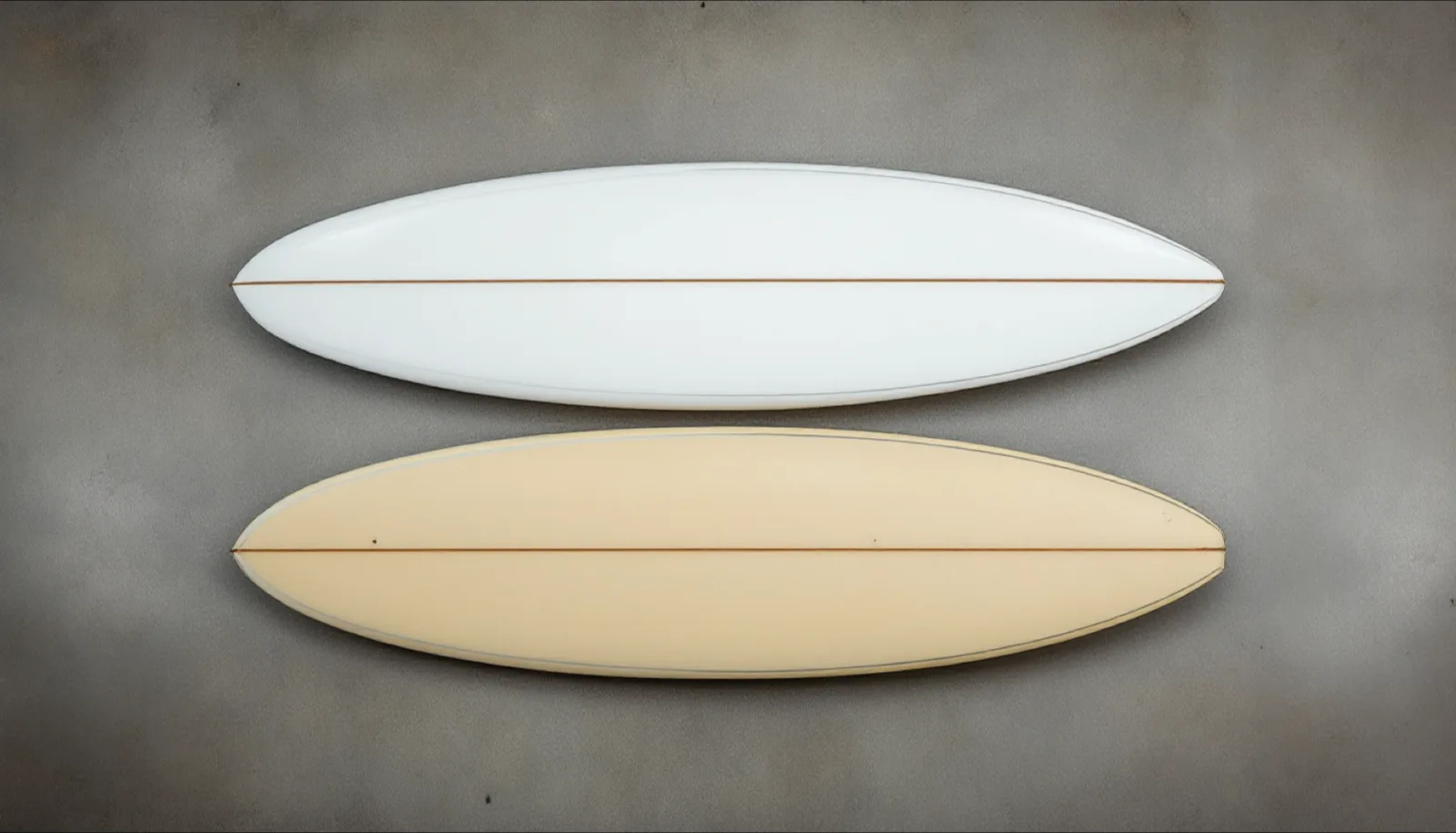
Hard surfboards and paddleboards are built one of two ways. The first is an EPS core laminated with epoxy resin. EPS is expanded polystyrene: the white, grainy foam that looks exactly like a disposable picnic cooler. The second is a polyurethane (PU) core laminated with polyester resin. PU is the older, long-established standard in surfboard building. Both constructions can look identical from the outside, which is where repairs go wrong.
The reason the distinction matters comes down to chemistry. Polyester resin contains styrene — not as a trace impurity, but as a named ingredient. When polyester resin contacts an EPS foam core, the styrene dissolves it. The foam doesn't just get damaged; it actively breaks down beneath the repair. A board that looks fixed on the surface can have a hollow, degraded core underneath.
If you can see white, grainy foam in the ding, you have an EPS core. Do not use polyester resin on it under any circumstances — the styrene it carries will dissolve the foam on contact.
The rule is straightforward: EPS cores require epoxy resin. PU cores work with polyester resin. If you are unsure which construction your board has, look at the exposed foam in the damaged area. Grainy and white means EPS. Everything else about the repair — which kit, which technique — follows from that single identification.
How to Tell Which Board You Have (Without Cutting It Open)
The two common hard-board constructions are an EPS (expanded polystyrene) foam core laminated with epoxy resin, and a polyurethane (PU) foam core laminated with polyester resin — and the one you have decides which resin you can safely use.
Check the manufacturer first. Most board brands publish construction specs on their websites or in their original paperwork. If yours lists "epoxy" or "EPS," that tells you everything you need. If it says "PU" or "polyurethane," same story.
Pick it up. EPS builds tend to run lighter than comparable PU boards, so if yours feels surprisingly light for its size, that nudges toward EPS.
Look at the foam inside an open ding. This is the most reliable field test. EPS is bright white and visibly granular — the same texture as a disposable cooler or coffee cup. PU foam is denser, and runs off-white to yellowish. If you can see the core through the damage, a quick look usually settles it.
Polyester resin carries a styrene solvent that dissolves EPS foam. Never let polyester resin contact an EPS or styrofoam core — the damage goes well beyond the original ding.
Decision Tree
- Polyester resin is your route.Certain it's PU (polyurethane core)
- Use an epoxy or universal resin only.Certain it's EPS (epoxy/expanded polystyrene core)
- Go universal. Phix Doctor's universal and Dura Resin products are solvent free and explicitly safe on both EPS and polyurethane cores, so you don't need to be certain.Not sure — construction unknown
What Happens If You Use the Wrong Resin
Polyester resin dissolves EPS foam — not slowly, not superficially, but chemically, from the moment it makes contact with the core.
The mechanism is straightforward. Polyester resin carries styrene as a solvent, and styrene attacks expanded polystyrene (EPS), the foam used in most epoxy-construction boards. This is not a cautionary inference drawn from chemistry textbooks. Styrene is named on the product itself: the Polyester Resin carries a California Proposition 65 warning stating the product "can expose you to chemicals including STYRENE MONOMER, which is known to the State of California to cause cancer." If it is aggressive enough to warrant a cancer warning, it is aggressive enough to eat through your board's core.
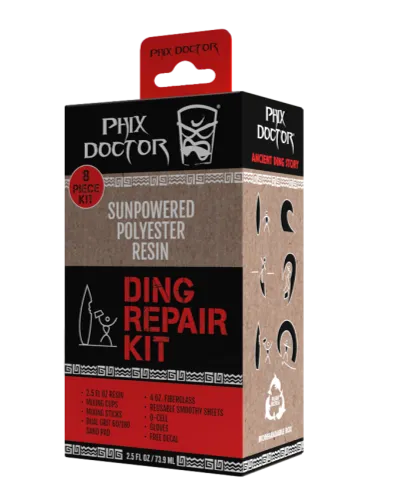
The SunPowered Polyester Repair Kit is unambiguous on the point: "This product is not for use on EPS/Styrofoam cores commonly used in Epoxy boards." That sentence is on the product, not buried in a FAQ.
The Polyester Repair Kit does acknowledge one narrow technical exception: if the resin never contacts the foam at all, it can work. But the same source frames this as a condition to be avoided, not a workaround to attempt — the guidance is to "never allow this resin" to reach the foam. That is a warning written for someone who already knows exactly what they are doing and has a specific reason to use polyester on an epoxy-construction board. It is not a green light for a standard ding repair.
If your board has an EPS core — common in most modern epoxy boards and all inflatable-adjacent constructions — reach for an epoxy repair product. Using polyester resin on EPS does not produce a bad repair; it produces a worse problem than the ding you started with.
Three Repair Routes Phix Doctor Sells — and Which Board Each Fits
The right resin depends on one thing above all else: what your board's core is made of. Get that wrong and you can dissolve the foam before you've fixed the ding.
The styrene solvent in polyester resin dissolves expanded polystyrene (EPS/styrofoam) cores. If your board is epoxy or you're not certain of the core material, use a universal or epoxy-specific product instead.
Here's how the three routes compare:
| Product | Price | Safe on EPS/Epoxy boards | Safe on PU/Polyester boards |
|---|---|---|---|
| Route 1 — Universal (works on any board) | |||
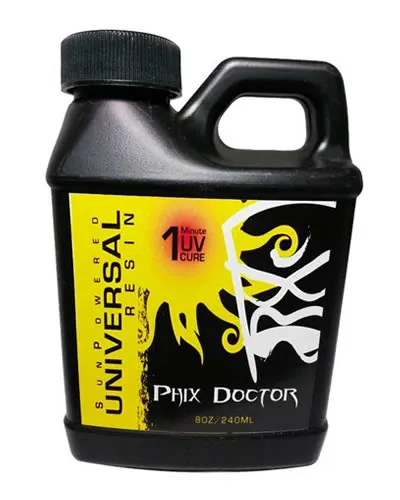
| SunPowered Universal Resin — Epoxy/Poly Safe Half Pint | $39.90 | ✓ Solvent-free, explicitly EPS/epoxy safe | ✓ |
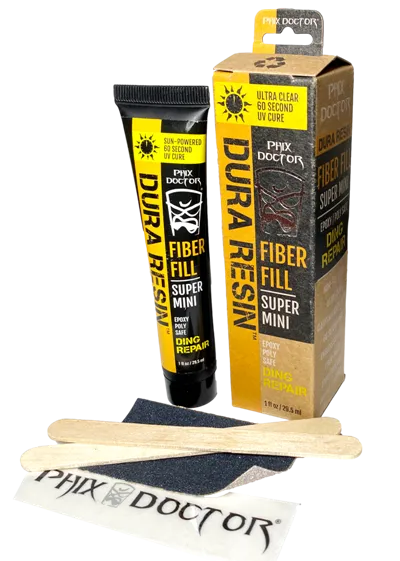
| Super Mini SunPowered Dura Resin Fiberfill Kit 1 oz | $7.90 | ✓ Safe for ultra-light styrofoam cores | ✓ |
| MONDO Dura Resin UV Filler Ding Repair Tube | $7.90 | ✓ Safe for ultra-light foam cores in epoxy or polyester boards | ✓ |
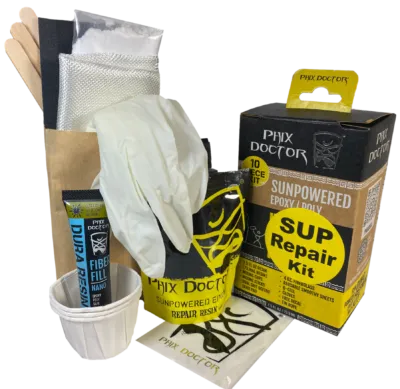
| SUP/Paddleboard Repair Kit | $27.90 | ✓ Safe on delicate styrofoam cores | ✓ |
| Route 2 — Epoxy boards | |||
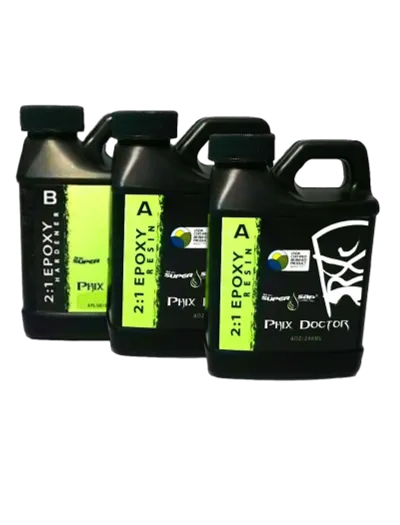
| 2:1 Super SAP Bio-Based Epoxy Resin 24 oz | $58.00 | ✓ Plant-based epoxy, used by board manufacturers | — |
| Route 3 — PU/Polyester boards only | |||
| SunPowered Polyester Repair Kit | $14.80 | ✗ Not for use on EPS/styrofoam cores | ✓ |
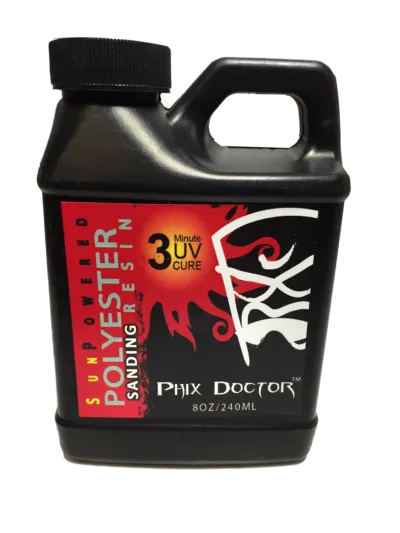
| SunPowered Polyester Resin Half Pint | $14.95 | ✗ Not for use on EPS/styrofoam cores | ✓ |
A few notes that keep repairs from going sideways:
Route 1 is the lowest-friction choice if you're unsure of your core material or you repair multiple boards. The Dura Resin products cure in as little as one minute in sun; for thick applications on ultra-light foam, flash the repair in and out of sunlight in 10–15 second intervals rather than leaving it in direct sun continuously.
Route 2 makes sense when you're doing a structural repair on an epoxy board and want a resin that matches what the manufacturer used. The Super SAP is 37% bio-based and comes in a 24 oz volume suited to larger jobs.
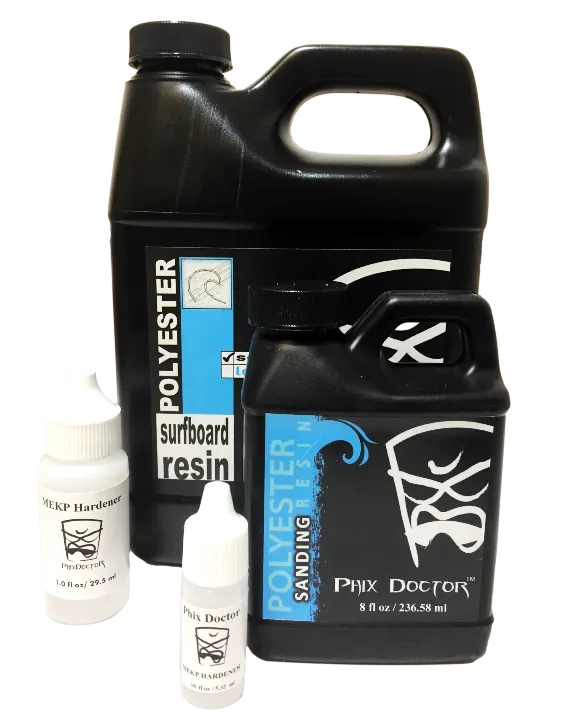
Route 3 costs less per ounce and the Silmar-brand polyester resin in both products hardens in as little as three minutes in full sun — but these are strictly for boards with polyurethane foam cores. The styrene solvent they contain will eat an EPS core on contact.
UV Resin Tips That Apply Whichever Route You Choose
Two curing facts hold true regardless of which UV resin product you use.
The cover sheet is not optional. Before moving the repair into sunlight, lay a clear plastic sheet over the wet resin. It creates an oxygen-free environment that allows the resin to fully cure in as little as one minute. Skip it and the top layer stays tacky — the cure simply won't complete.
Go easy with heat on light foam cores. Heat is a natural byproduct of the curing process with all resins. On ultra-light styrofoam or delicate epoxy cores, don't park the board in full sun and walk away. Flash the repair in and out of direct sunlight in short intervals instead — the MONDO Dura Resin listing specifies 10 or 15 second intervals for thick amounts of resin or any UV-activated resin on delicate foam. This lets the resin cure without driving heat into the core.
The interval method and the cover-sheet requirement are chemistry, not brand-specific instructions. If you're using a different UV resin on a light foam board, the same logic applies.
Frequently asked questions
Can I use polyester resin on an epoxy board?
No — not if the resin will contact the foam core. Polyester resin contains styrene, a solvent that dissolves EPS (expanded polystyrene) foam. The SunPowered Polyester Repair Kit states plainly: 'This product is not for use on EPS/Styrofoam cores commonly used in Epoxy boards.' If you are unsure of your board's construction, use a solvent-free universal resin instead.
What resin is safe for a styrofoam core surfboard?
A solvent-free universal or Dura Resin product is the right choice. Phix Doctor's SunPowered Universal Resin is described as safe on EPS and polyurethane foam core boards, and Dura Resin is described as safe for ultra-light styrofoam cores as well as polyurethane cores. Polyester resin must not be used on styrofoam cores.
How do I tell if my surfboard is EPS or polyurethane foam?
Check any foam visible inside an open ding: EPS is white and granular, like a picnic cooler; polyurethane foam is denser and typically off-white or yellowish. You can also check the manufacturer's published specs for your model. If you cannot confirm the construction, a solvent-free universal resin is safe on both types.
Is there a universal surfboard repair resin that works on both epoxy and polyester boards?
Yes. Phix Doctor's SunPowered Universal Resin - Epoxy / Poly Safe - Half Pint ($39.90) is described as solvent-free and safe on both EPS/epoxy and polyurethane/polyester foam core boards. The Dura Resin range and the SUP/Paddleboard Repair Kit also use resins described as safe on both foam types.
Does polyester resin really melt styrofoam?
Yes. Polyester resin contains styrene monomer — named on the product label in a California Proposition 65 warning — which dissolves EPS (expanded polystyrene) foam on contact. Phix Doctor advises never allowing polyester resin to reach an EPS foam core.
Products in this guide
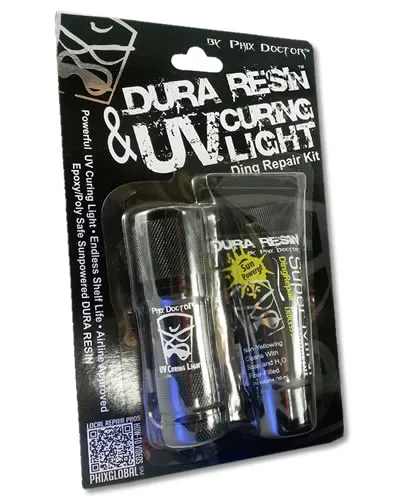
SunPowered Dura Resin Combo W/UV Light
$28.00
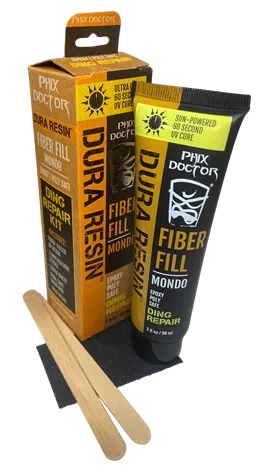
MONDO Dura Resin UV Filler Ding Repair Tube
$7.90
Super Mini SunPowered Dura Resin Fiberfill Kit 1oz
$7.90
2:1 Super SAP Bio-Based Epoxy Resin 24 oz
$58.00
SunPowered Universal Resin - Epoxy / Poly Safe - Half Pint
$39.90
SUP/Paddleboard Repair Kit by Phix Doctor
$27.90
Phix Doctor SunPowered Polyester Resin - Half Pint
$14.95
Phix Doctor Polyester Resin - Half Pints, Quarts & Gallons
$14.95
SunPowered Polyester Repair Kit
$14.80
Phix Doctor Q-Cell Foam Filler
$3.50