Table of Contents
13 min read
Best Surfboard Ding Repair Kit for Beginners (Tube vs. Kit, and the One Thing You Must Get Right First)
For a single small ding, a fiber-filled UV resin tube starting at $7.90 is usually enough. A kit earns its money when the ding needs fiberglass cloth or…

Tube or Kit? The Honest Rule for Beginners
For most beginners, a squeeze tube or a micro kit handles 80% of real-world dings — you only need a full kit when the glass is broken through.
Here's the plain fork: if the fiberglass skin is still intact and you're filling a surface ding, a fiber-filled UV resin tube or a pocket-sized micro kit is all you need. If the ding has punched through the glass and you need to lay up a patch — or if you'd rather open one box and find gloves, q-cell, mix cups, sandpaper, and fiberglass already inside — step up to a kit.
The tube and micro-kit end of the shelf runs from $3.90 to $7.90:
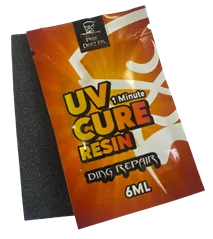
- The SunPowered Phix Doctor Micro Kit at $3.90 includes sunpowered resin, sandpaper, a smoothy sheet, and instructions. Safe on EPS (epoxy/Styrofoam) and polyester cores, endless shelf life, cleans up with soap and water.
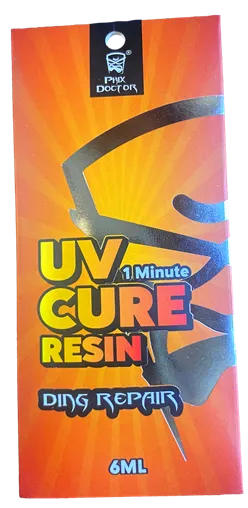
- The Deluxe Micro Kit at $4.99 adds a dual 60/220 grit sand pad, a bamboo application stick, and a cover sheet — and it's airline approved, so it travels with you.
- The Super Mini SunPowered Dura Resin Fiberfill Kit 1oz and the MONDO Dura Resin UV Filler Ding Repair Tube both sit at $7.90 — more resin volume if you've got a few dings to knock out at once.
The kit end of the shelf starts at $19.90 and includes fiberglass cloth:
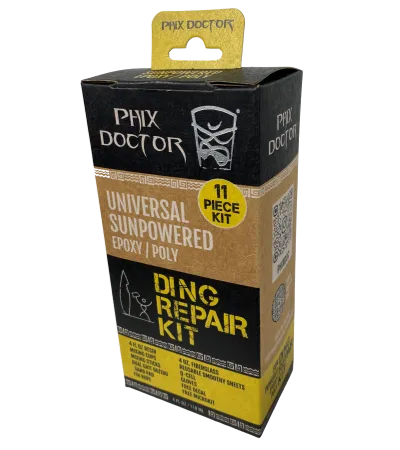
- The SunPowered Epoxy/Poly Repair Kit — UNIVERSAL! at $19.90 packs in UV resin, q-cell, a dual-grit sand pad, gloves, and other consumables. Works on both epoxy and poly boards, hardens in as little as 1 minute, zero fumes.
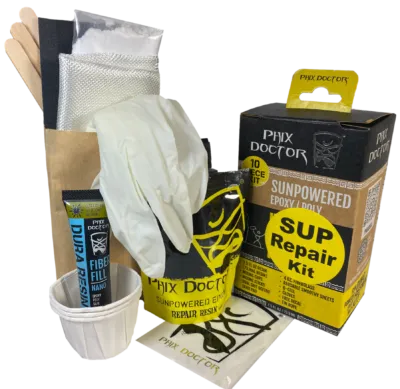
- The SUP/Paddleboard Repair Kit by Phix Doctor at $27.90 adds a sheet of 4 oz e-glass fiberglass (7×13 in), mix cups, mix sticks, smoothy sheets, and instructions in 7 languages — the right call for a SUP with a proper structural ding.
Every product above uses UV resin with endless shelf life — it won't kick until you take it into sunlight, so it stores in a hot car, a glove box, or a bag without going off.
Decision Tree
- grab a Micro Kit ($3.90–$4.99) or a Dura Resin tube ($7.90); no cloth needed.Surface ding, glass still intact
- go with the SunPowered Epoxy/Poly Kit ($19.90) or the SUP/Paddleboard Kit ($27.90).Glass broken through, or want gloves, fiberglass, and consumables included
The One Thing You Must Get Right Before Buying: Which Resin Your Board Can Take
Before you buy anything, figure out what your board is made of — getting this wrong can destroy the core.
Two constructions, two rules. Most hard boards are one of two things:
- EPS / epoxy — the core is expanded polystyrene, the white grainy foam that looks exactly like a picnic cooler. It's laminated with epoxy resin.
- PU / polyester — the core is polyurethane foam, denser and less crumbly, laminated with polyester resin.
Flip the board, look at a ding, or ask the shaper. If you see that white, beady, cooler-looking foam, you have an EPS board. That changes everything about which resin you can use.
The hard rule: polyester resin and EPS foam cannot meet. Polyester resin contains styrene monomer — not as a trace impurity, but as a named ingredient on the label. Both the Polyester Repair Kit and the SunPowered Polyester Repair Kit carry a California Proposition 65 warning stating the product "can expose you to chemicals including STYRENE MONOMER, which is known to the State of California to cause cancer." Styrene is a solvent. It dissolves EPS foam. The Polyester Repair Kit puts it plainly: "No, polyester resin is not compatible with styrofoam core boards… So we advise to never allow this resin to be in contact with styrofoam (EPS) cores." The SunPowered Polyester Repair Kit is equally direct: "This product is not for use on EPS/Styrofoam cores commonly used in Epoxy boards."
There is no workaround. If polyester resin reaches the foam, the foam dissolves.
Styrene monomer, the solvent in polyester resin, actively dissolves expanded polystyrene foam. No technique or application method makes polyester safe on an EPS core.
If you're not certain, buy a universal resin and skip the decision entirely. The following products are solvent-free and explicitly rated safe on both EPS and polyurethane cores:
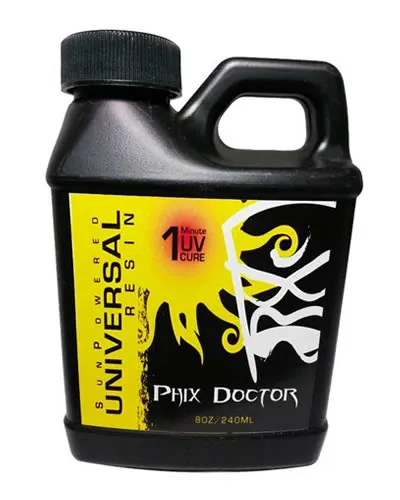
- SunPowered Universal Resin Half Pint — "Safe on delicate Epoxy/EPS, and Polyurethane Foam Core Boards! Solvent Free"
- SunPowered Micro Kit — "Safe on Delicate EPS (Epoxy) or Polyurethane Core Boards"
- SUP/Paddleboard Repair Kit — "Safe on delicate Styrofoam Cores"
- Dura Resin — "Safe for delicate, ultra light styrofoam cores as well as the old standard polyurethane board cores"
Being solvent-free is exactly what makes these resins safe on the foam that polyester attacks. One customer who learned this the easy way put it well: the Micro Kit is "the handiest repair kit around" — and that portability means you can keep one in your bag regardless of which board you grab that day.
If you already know you have a PU board, polyester kits are a legitimate choice. If there's any doubt, go universal.
The Kits at Real Prices: From Pocket Micro to Full Repair Box
Here's every kit in the line, cheapest to most complete, with exactly what's in the box and who actually needs it.
| Kit | Price | What's in the box | Best for |
|---|---|---|---|
| SunPowered Phix Doctor Micro Kit | $3.90 | UV resin, sandpaper, smoothy sheet, instructions | Anyone who wants a true pocket repair — safe on EPS and PU, no fiberglass included |
| Deluxe Micro Kit | $4.99 | 6g universal UV resin, 60/220 dual grit sand pad, bamboo application stick, logo sticker | Travel-focused surfers; Phix Doctor describes it as airline approved — confirm with your carrier |
| Super Mini SunPowered Dura Resin Fiberfill Kit 1oz | $7.90 | 1 fl oz Dura Resin, dual grit sand pad, 2 mix sticks, 2 smoothy sheets | Step up from the micro when the ding needs a bit more resin; Phix Doctor describes it as airline approved — confirm with your carrier |
| MONDO Dura Resin UV Filler Ding Repair Tube | $7.90 | 2 oz Dura Resin tube, 60/220 dual grit sand pad, 2 applicators, 2 smoothy sheets | Same price as the Super Mini but twice the resin — right choice when you're fixing something bigger; Phix Doctor describes it as airline approved — confirm with your carrier |
| SunPowered Epoxy/Poly Repair Kit — UNIVERSAL | $19.90 | Universal UV resin, q-cell, dual grit sand pad, gloves, and additional items | Surfers who want a fuller kit that still works on both EPS and PU boards; Phix Doctor describes it as airline approved — confirm with your carrier |
| SUP/Paddleboard Repair Kit | $27.90 | Universal UV resin 0.5 fl oz nano tube, q-cell, 2 gloves, dual grit sand pad, smoothy sheets, mix cups, mix sticks, 7×13 in fiberglass 4 oz e-glass, instructions in 7 languages, logo sticker | SUP and paddleboard owners who need fiberglass for structural repairs; safe on EPS cores |
| SunPowered Dura Resin Combo W/UV Light | $28.00 | 1 fl oz Dura Resin, UV curing light, dual grit sand pad, 3 mix sticks, 2 smoothy sheets | Dawn patrol surfers or anyone repairing indoors — the light means you're not waiting on the sun |
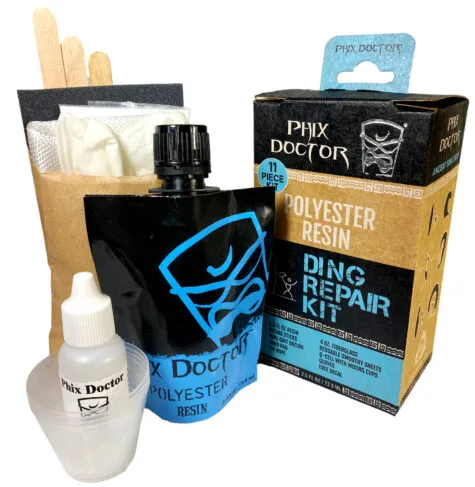
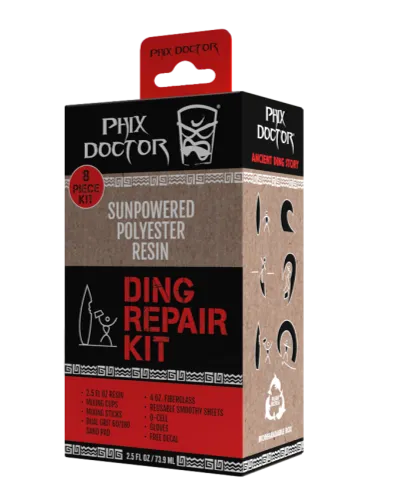
| SunPowered Polyester Repair Kit | $14.80 | Silmar sanding resin, q-cell, gloves, dual grit sand pad, smoothy sheets, mix cups, mix sticks, 7×13 in fiberglass 4 oz e-glass, instructions in 7 languages, logo sticker | PU-core (polyester) boards only — not for EPS/Styrofoam cores |
| Polyester Repair Kit | $14.80 | Silmar sanding resin, hardener, q-cell, 2 gloves, dual grit sand pad, smoothy sheets, mix cups, mix sticks, 7×13 in fiberglass 4 oz e-glass, instructions in 7 languages, logo sticker | PU-core boards only; uses a catalyst rather than UV cure — not for EPS/Styrofoam cores |
Both polyester kits — the SunPowered and the standard — will dissolve a Styrofoam (EPS) core on contact. If your board is epoxy or you're not certain of the core material, choose any of the UV kits above instead.
A few things worth noting as you scan the table. The two $7.90 kits are genuinely different choices: the Super Mini gives you 1 fl oz in a tube with mix sticks, while the MONDO gives you 2 oz of Dura Resin for the same price — if the ding is more than a pressure dent, the MONDO is the better value. The jump from $19.90 to $27.90 buys you fiberglass cloth and a SUP-specific format. And the $28.00 UV Light combo is essentially the 1 fl oz Dura Resin kit with a curing light added — worth it if you're regularly fixing boards before sunrise or in a garage.
Your First Repair, Step by Step
A first ding repair has five steps, and none of them require prior experience.
How it works
- 1Clean the ding.Remove wax from the area around the damage, then rinse out any sand and salt. You want bare, clean fiberglass or foam — nothing that will stop the resin from bonding.
- 2Dry the core completely.The board must be fully dry before any resin goes in. Wet foam and wet fiberglass will trap moisture under the repair, so don't rush this step.
- 3Fill the ding.Apply resin into the damage, slightly overfilling so you have material to sand back flush. A small excess is easier to deal with than a low spot.
- 4Cover with a clear sheet, then move into sunlight.Lay the included Smoothy Sheet flat over the wet resin before you step outside. That sheet creates an oxygen-free environment that allows the resin to fully cure in as little as one minute — skip it and the surface stays tacky no matter how long it sits in the sun.
- 5Peel, then sand flush.Pull the sheet off, then work the MONDO Dura Resin UV Filler Ding Repair Tube dual grit sand pad coarse-side-first to knock down the overfill, then flip to the fine side to smooth the surface.
Heat is a natural byproduct of curing. On ultra-light epoxy boards, move the repair in and out of direct sunlight in 10 or 15 second intervals rather than leaving it in full sun — this lets the resin cure without overheating the foam underneath.
The result will be a solid, watertight repair. Don't expect it to disappear visually or perform identically to the original laminate — that's not what a ding repair is for.
Three Beginner Mistakes Worth Naming
Most failed first repairs trace back to one of three errors, and all three are avoidable once you know what to watch for.
1. Repairing over a wet core. Resin will not bond to wet foam. If water has gotten into the board — and with any open ding, it has — the core needs to be fully dry before you touch it with resin. Rushing this step is the single fastest way to waste a kit. Let the board dry completely first; only then open the resin.
2. Leaving a delicate foam board baking in full sun while the resin cures. Heat is a natural byproduct of the curing process with all resins. On ultra-light foam cores, sustained direct sun can overheat the core before the resin has a chance to set properly. The right technique is to flash the board in and out of sunlight in short intervals — enough UV or warmth to drive the cure, not enough to cook the foam underneath.
3. Using polyester resin on an EPS board. This one causes real damage. Polyester resin carries styrene monomer — it's named directly on the Prop 65 warning on both the Polyester Repair Kit and the SunPowered Polyester Repair Kit — and styrene dissolves EPS (expanded polystyrene) foam on contact. If your board is an epoxy board with an EPS core, polyester resin is the wrong product, full stop. Reach for an epoxy-compatible kit instead.
Styrene monomer in polyester resin actively eats EPS foam. If you're not certain what core your board has, check before you mix — a wrong call here makes the ding worse, not better.
What a Beginner Should Not Attempt (Take These to a Shop)
Some damage genuinely requires a professional, and trying to fix it yourself without experience can leave you with a board that's worse off than when you started.
Here are the categories worth handing off:
Large delaminations. This is where the fiberglass skin has separated from the foam over a wide area — you can feel it flex or hear it crinkle when you press on it. Reinjecting resin into a big delamination without the right technique traps air, creates uneven bonds, and can make the separation spread. A shop has the tools and experience to assess whether it's even worth fixing.
Through-hull damage. If the board has been holed all the way through — you can see foam or daylight from the other side — that's a structural repair, not a ding fill. The foam may be waterlogged, the glass schedule needs to be rebuilt in layers, and getting it wrong means the repair fails under load.
Fin box damage. A cracked or pulled fin box is under serious stress every time you surf. Repairing it means removing material, rebuilding the box seat, and re-laminating around it correctly. A botched fin box repair can fail catastrophically in the water.
Rail and nose damage. The rail and nose take the most impact and flex stress on a board. Structural damage in these areas — not a surface chip, but actual crushed or missing foam with compromised glass — needs someone who can assess the extent of the damage before touching it.
If you're not sure whether something is a surface ding or something deeper, take it in. A shop assessment costs little or nothing, and it's a lot cheaper than a repair that makes the problem worse.
The kits and tubes on this site handle surface dings, pressure dings, and small cracks well. The jobs above are the ones where the honest answer is: put the resin down and find a shaper.
Frequently asked questions
What do I need to fix a small surfboard ding?
For a small surface ding you need a fiber-filled UV resin, a clear cover sheet to exclude oxygen during cure, and a dual grit sand pad to finish. The SunPowered Phix Doctor Micro Kit at $3.90 and the MONDO Dura Resin tube at $7.90 both include these items. A larger kit adds fiberglass cloth, gloves, and q-cell for dings that have broken through the glass.
Can I use any surfboard repair resin on an epoxy board?
No. Polyester resin contains styrene monomer, a solvent that dissolves EPS foam cores used in epoxy boards. Use only a resin specifically rated safe for EPS, such as Phix Doctor's Dura Resin or universal resin products, which are solvent-free and rated safe on both EPS and polyurethane foam cores.
Why does my repaired ding stay tacky and not fully cure?
A tacky surface after UV cure almost always means the cover sheet was not used. The clear cover sheet creates an oxygen-free environment over the wet resin; without it, oxygen prevents the top layer from curing fully. Apply the sheet before moving the repair into sunlight.
Is a surfboard repair kit allowed on a plane?
Phix Doctor describes the Deluxe Micro Kit, the Super Mini SunPowered Dura Resin Fiberfill Kit, the MONDO Dura Resin UV Filler Ding Repair Tube, and the SunPowered Epoxy/Poly Repair Kit as airline approved. That is the manufacturer's description of those specific products — confirm with your carrier before travel, as airline rules vary.
How do I know if my surfboard has an EPS or polyurethane foam core?
EPS foam is white and grainy, similar in appearance to a picnic cooler. Polyurethane foam is denser and yellower. If you are unsure, choose a universal or Dura Resin product — both are rated safe on EPS and polyurethane cores, removing the need to identify the construction before buying.
Products in this guide
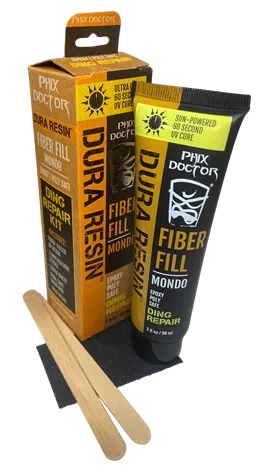
MONDO Dura Resin UV Filler Ding Repair Tube
$7.90
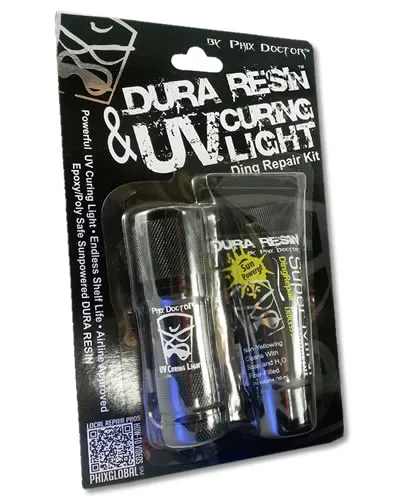
SunPowered Dura Resin Combo W/UV Light
$28.00
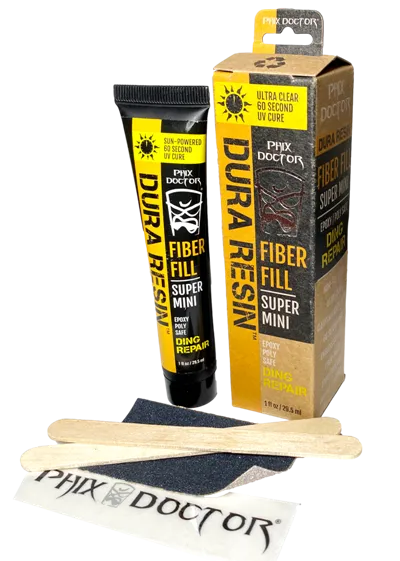
Super Mini SunPowered Dura Resin Fiberfill Kit 1oz
$7.90
Deluxe Micro Kit
$4.99
SunPowered Phix Doctor Micro Kit
$3.90
SunPowered Universal Resin - Epoxy / Poly Safe - Half Pint
$39.90
SUP/Paddleboard Repair Kit by Phix Doctor
$27.90
SunPowered Epoxy/Poly Repair Kit - UNIVERSAL!
$19.90
2:1 Epoxy Repair Kit
$19.70
SunPowered Polyester Repair Kit
$14.80