Table of Contents
10 min read
Softboard Repair: Why a Normal Ding Kit Fails on a Foamie — and What to Use Instead
A standard laminating or polyester resin will crack out, refuse to bond, or dissolve the foam inside a soft-top surfboard. The fix is a flexible polymer…
What a Soft-Top Is Actually Made Of — and Why It Breaks Differently
A soft-top is not a single material — it is a sandwich of three chemically distinct layers, and that sandwich is exactly what makes it fail (and repair) differently from a standard hard board.
The outer deck is a layer of EVA foam skin: the soft, grippy surface you stand on. The bottom is an HDPE plastic sheet — slick, hard, and designed to shed water. Between those two skins sits a rigid foam core, typically EPS (expanded polystyrene) — the same white, grainy foam you would recognize from a picnic cooler. Each layer is bonded to the next, and those bond lines are where damage almost always begins. The outer skins flex under a rider's weight and under impact; the rigid core underneath does not flex at the same rate. That mismatch puts constant stress on the interfaces, so delamination — the layers separating rather than the foam itself cracking — is the characteristic soft-top failure mode.
This construction creates a specific chemical constraint that catches a lot of people out. Polyester resin carries styrene monomer as a solvent — it is listed by name on the Phix Doctor Polyester Repair Kit under a California Proposition 65 warning. Styrene dissolves EPS foam on contact. That means polyester resin must never reach the core of a soft-top board. As the Polyester Repair Kit puts it directly: polyester resin is not compatible with styrofoam core boards, and even when the outer skin is intact, you should never allow the resin to reach the foam.
If polyester resin contacts the expanded polystyrene core — even briefly, even in a small repair — the styrene solvent dissolves the foam. The damage is irreversible and typically worse than the original ding.
This is not a soft-top-specific quirk. The same rule applies to any board built around an EPS core, including many modern epoxy hard boards. The practical test: if the exposed foam looks white and granular, like a styrofoam cup, treat it as EPS and keep polyester resin away from it entirely. A soft-top's EVA deck and HDPE bottom mean you are almost certainly dealing with an EPS core — and that means the repair product you reach for has to be chosen accordingly.
Why a Rigid Ding Kit Will Fail on a Foamie
The repair kits sold for glassed, rigid shortboards are engineered for a surface that barely moves — and that's exactly the problem on a softboard.
Every wave, every footstrike, every time you toss the board into the back of a car, the EVA deck and HDPE bottom flex. A laminating resin cures hard. It cannot flex with them. The result is predictable: the repair cracks out, or the edges peel away, and water finds its way back in faster than before.
Polyester resin adds a second, more serious problem. It carries styrene — not an inference, but a named chemical on the product's own California Proposition 65 warning label. Styrene dissolves expanded polystyrene foam. Let polyester resin reach an EPS core and you are not repairing the board; you are eating it from the inside.
Styrene — the solvent polyester carries — dissolves expanded polystyrene. Even a small amount of contact with the foam causes irreversible damage.
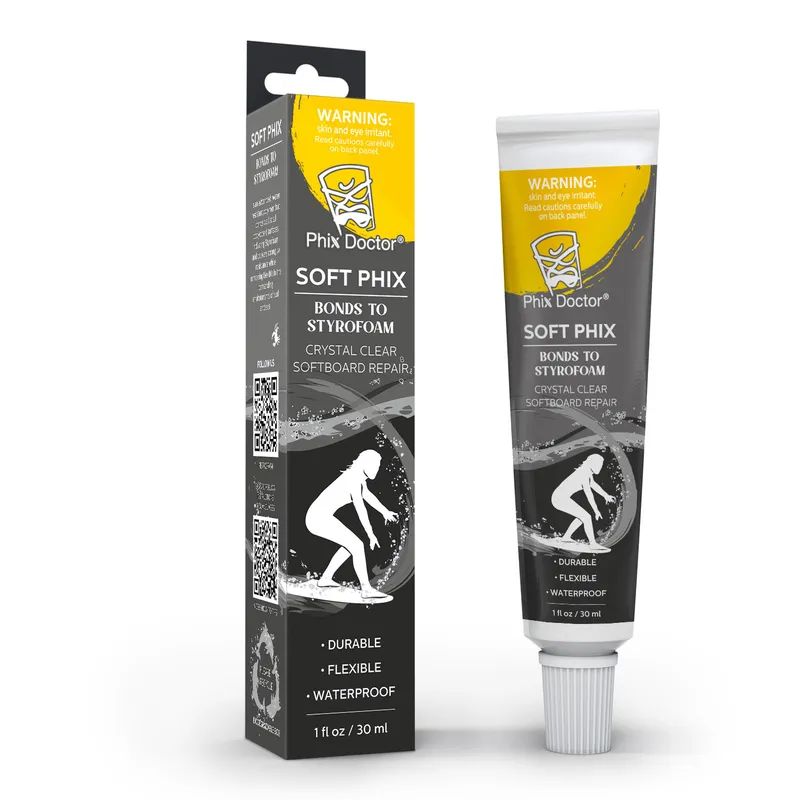
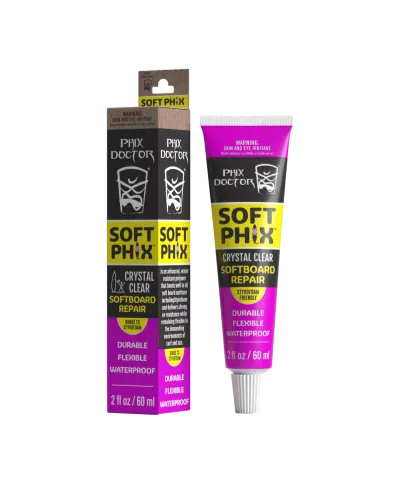
The right answer for a softboard is a flexible bonding polymer, which is exactly what Soft Phix is. It cures ultra-clear, UV-resistant, waterproof, and — critically — super flexible, so it moves with the board instead of fighting it. It bonds to the actual materials softboards are made from: EVA, HDPE, Styrofoam/EPS, rubber, wood, and metal. Nothing is substituted or assumed there; those are the specific surfaces the formula is built for.
Which Repair Does Your Foamie Actually Need?
The damage type determines the technique — and on a softboard, getting that wrong means water keeps finding its way in regardless of how much product you apply.
A small ding on a foamie rarely looks serious, but softboards take constant abuse: tossed into vehicles, dropped on the beach, flexed hard through turns. Each of those stresses produces a different failure mode, and each one needs to be read correctly before you reach for anything.
Four damage types, four distinct jobs:
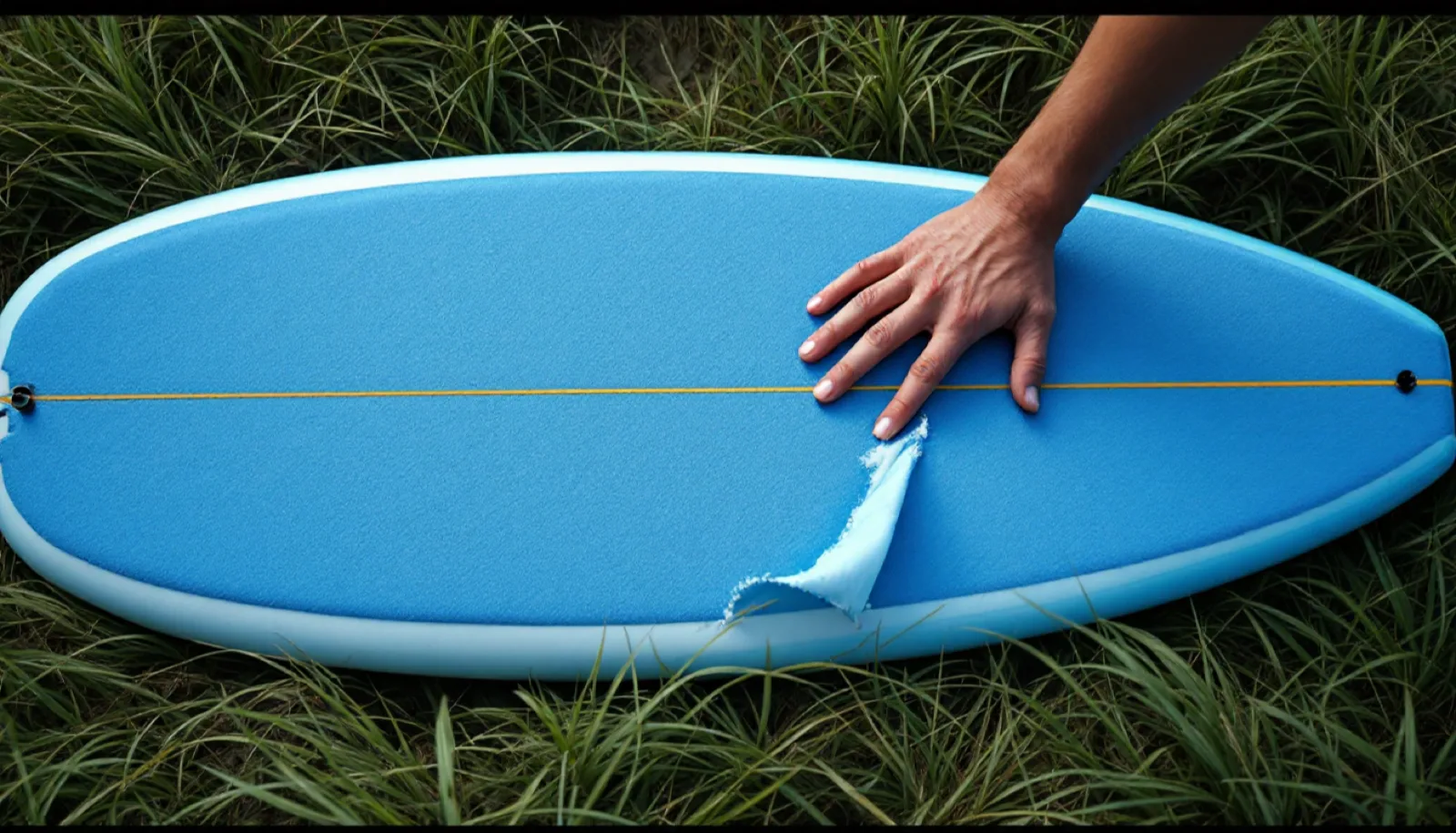
1. Torn or gouged EVA deck. A fin strike, a rocky beach landing, or a hard wipeout tears or scoops material out of the foam skin on top. The surface is open, the core is exposed, and water will track inward fast. This is the most common foamie repair and the most urgent — an open gouge that looks minor at the beach can saturate a surprising amount of core by the next session.
2. Delaminating or lifting deck skin. Press the deck and it flexes in a way it shouldn't, or you can see a bubble forming under the EVA layer. The skin is separating from the core beneath it. The gap needs to be filled and bonded, not just surface-sealed — a top coat alone will bridge the void without addressing it.
3. Split seam or rail. The join between the deck and the bottom panel opens under repeated flex stress. Rail splits let water in along the full length of the separation and are easy to underestimate because the board can still feel rideable.
4. Punctured or cracked HDPE slick bottom. Impact damage to the hard plastic underside — a rock strike, a reef hit, or a hard fin-over landing. The repair material needs to bond to HDPE specifically, which many general adhesives handle poorly.
Decision Tree
- Soft Phix fills deep holes and rips in EVA and EPSFoam skin torn, scooped, or gouged on the deck
- Soft Phix fills delaminations and bonds to EPS and EVADeck feels soft or bubbled — skin lifting from core
- Soft Phix fills and seals split seams on softboard materialsRail or seam has opened along the join line
- Soft Phix bonds to HDPE slick bottoms; so does Bodyboard Weld & Seal if you also need a bodyboard-specific kitHard plastic underside cracked or punctured
Applying repair material only to the top of a bubble traps the void underneath. Work the formula into the gap so it fills the separation and bonds the skin back to the core — otherwise the bubble returns within a few sessions.
How to Repair a Soft-Top Surfboard: The Right Method, Step by Step
Repairing a soft-top correctly comes down to two things most people skip: a genuinely clean, dry surface before you touch the resin, and thin layers instead of one thick fill. Get those two right and the repair holds; get either one wrong and you're peeling it back out within a few sessions.
The instinct to pack a deep ding in one go is understandable — it looks faster. The problem is that a thick single application can skin over on the outside while the material underneath stays uncured. Thin layers let each pass cure properly before the next one goes on. The same logic applies to surface prep: saltwater, wax residue, and any loose or delaminated foam will all break adhesion before it even starts.
A small ding that looks harmless grows quickly once water starts getting in. Fix it before the next session, not after.
How it works: repairing a soft-top ding with Soft Phix
- 1Clean the area.Remove all wax, salt residue, and dirt from around the damage. The surface must be fully dry — not just towel-dry, but genuinely dry — before any resin is applied.
- 2Clear out loose material.Pick or trim away any delaminated foam or skin. Soft Phix bonds well to EPS, EVA, HDPE, rubber, and the other materials that make up a softboard's construction, but it cannot bridge over material that has already lost its bond.
- 3Apply a first thin layer.Work Soft Phix into the damage as a thin coat rather than filling the cavity in one pass. The formula is super flexible and ultra clear, so it moves with the board rather than cracking under flex.
- 4Wait for medium-strength cure.Allow 24 hours before adding any subsequent layer. This is the step most repairs skip — pulling the board back into use at this stage risks deforming the repair before it has set.
- 5Build up additional layers if needed.For deeper holes or delaminations, repeat steps 3 and 4, adding one thin layer at a time until the repair is flush.
- 6Allow full cure before surfing.Full cure is reached at 48 hours. The repair is then waterproof and ready for regular use.
Soft Phix Sizes and Prices: Which Amount Do You Need?
Two sizes cover most repair scenarios, and the right one depends on how much damage you're dealing with.
- Soft Phix Softboard Repair Kit 1 fl oz — $11.90, in stock. The go-to for a single ding, small split seam, or a loose leash plug. The formula is waterproof, super flexible, and carries an endless shelf life, so whatever you don't use stays ready for the next session.
- Soft Phix Softboard Repair Kit 2 fl oz — in stock. The larger volume is worth having if you're tackling deeper holes, wider delaminations, or multiple repairs in one go. It bonds to EPS, EVA, HDPE, rubber, wood, and metal, reaches medium-strength cure in 24 hours, and full cure in 48 hours.
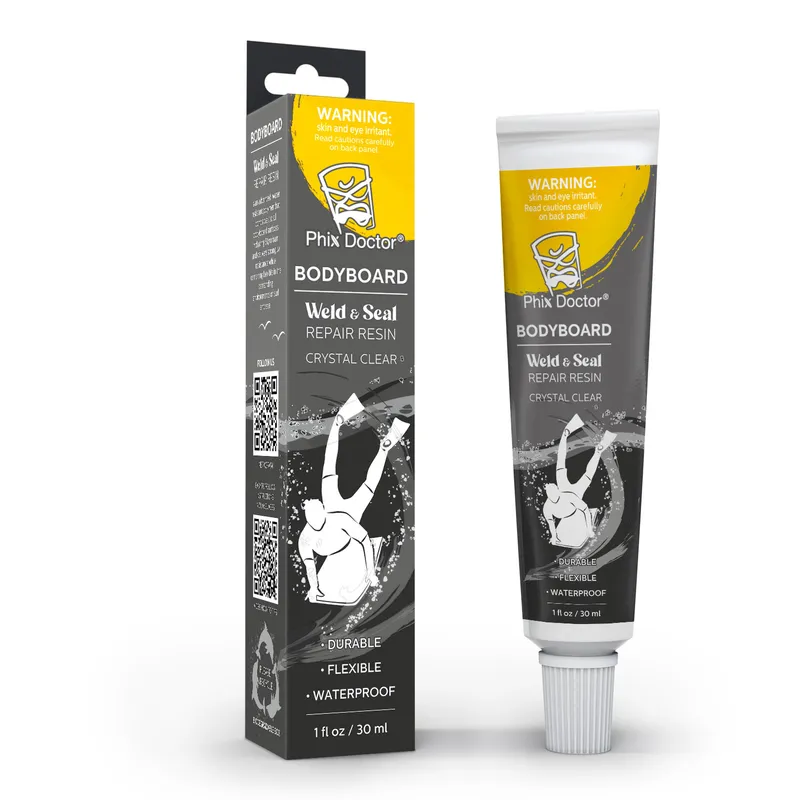
Also worth considering: the Bodyboard Weld & Seal Repair Resin 1 fl oz at $11.90 uses the same flexible polymer chemistry and lists the same overlapping compatible materials — EPS, HDPE, EVA, rubber, wood, and metal — making it a practical option if you're working on a bodyboard or any board with a slick bottom.
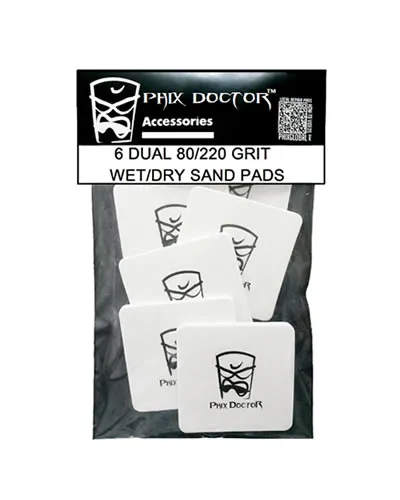
Surface prep add-on: the 6 Dual Grit Sand Pads at $3.95 are a 6-pack of 3" × 3" foam-centered pads in 80/150 grit. They're made with white silica specifically so no dark residue shows up in the finished repair — a small detail that matters on a light-colored softboard deck.
If the core is waterlogged, structurally compressed, or the delamination covers a large area, any of these products can restore surface integrity — but they cannot rehabilitate a compromised core. At that point, replacement is the more honest call.
Frequently asked questions
Can I use a regular surfboard ding kit on a soft-top?
No. Standard laminating and polyester resins are rigid when cured and will crack out as the soft-top's EVA deck and HDPE bottom flex. Polyester resin also carries styrene solvent, which dissolves EPS foam cores. A flexible polymer such as Phix Doctor's Soft Phix is the correct choice for soft-top materials.
What is the best repair kit for a foamie surfboard?
Phix Doctor's Soft Phix is formulated specifically for soft-top construction. It is a super-flexible, UV-resistant, waterproof polymer that bonds to EVA, HDPE, Styrofoam/EPS, rubber, wood, and metal — the materials a soft-top is actually made from. It is available in 1 fl oz ($11.90) and 2 fl oz sizes.
How do I fix a delaminating soft-top surfboard deck?
Clean and dry the lifting area thoroughly, removing any loose material. Apply Soft Phix in thin layers rather than one thick fill — the product is designed to fill delaminations and bond the skin back to the core. Medium-strength cure is reached in 24 hours; full cure in 48 hours.
Is Soft Phix safe on EPS foam cores?
Yes. Soft Phix bonds to Styrofoam/EPS per its product description. It does not carry the styrene solvent found in polyester resins, which is what makes polyester unsafe on EPS. Always ensure the surface is clean and dry before applying.
Can Soft Phix repair a split seam or rail on a soft-top?
Split seams are listed among the damage types Soft Phix is designed to fill and bond. Clean the seam, ensure it is dry, and build the repair in layers. Because the rail flexes under use, the flexibility of the Soft Phix formula is what allows the repair to move with the board rather than cracking out.