Table of Contents
10 min read
Bodyboard & Skimboard Repair: Fixing Flexible Boards That Move
Bodyboards and skimboards fail differently from surfboards — they delaminate, split seams, and tear slick bottoms rather than crack fiberglass. The right…

Why Bodyboards and Skimboards Fail the Way They Do
Bodyboards and skimboards break down at their material boundaries, not through their bulk — and that distinction changes everything about how you repair them.
A bodyboard is a stack of dissimilar materials bonded together: a foam core (EPS, also called styrofoam, or Arcel), a high-density polyethylene slick bottom on the riding face, a PE or PP deck skin on top, and rail seams where those outer skins meet and wrap the core. Each layer has its own flex characteristic. Under the repetitive loading of waves — compression on takeoff, twist through a turn, impact on a wipeout — those layers move at different rates. The stress concentrates at the interfaces, which is exactly where the bond is already doing the most work. The result is predictable: the deck skin separates from the core (delamination), the rail seam splits open along its length, the slick bottom tears or bubbles away from the foam beneath it, or the nose foam crushes and the skin above it collapses inward. None of these failures look like the punctured fiberglass you'd see on a shortboard, because there is no fiberglass — the outer skins are thin thermoplastic sheets, not laminated cloth, and they peel rather than crack.
Skimboards follow a different logic. A wooden skimboard is a single homogeneous blank and tends to delaminate its glassed deck coating or split along the rail where any protective layer meets bare wood. A composite skimboard — foam core with fiberglass or carbon skins — behaves more like a hard surfboard in that the glass can fracture, but the core beneath is still soft foam, so an impact that cracks the skin can also crush the core directly underneath, leaving a void that draws water.
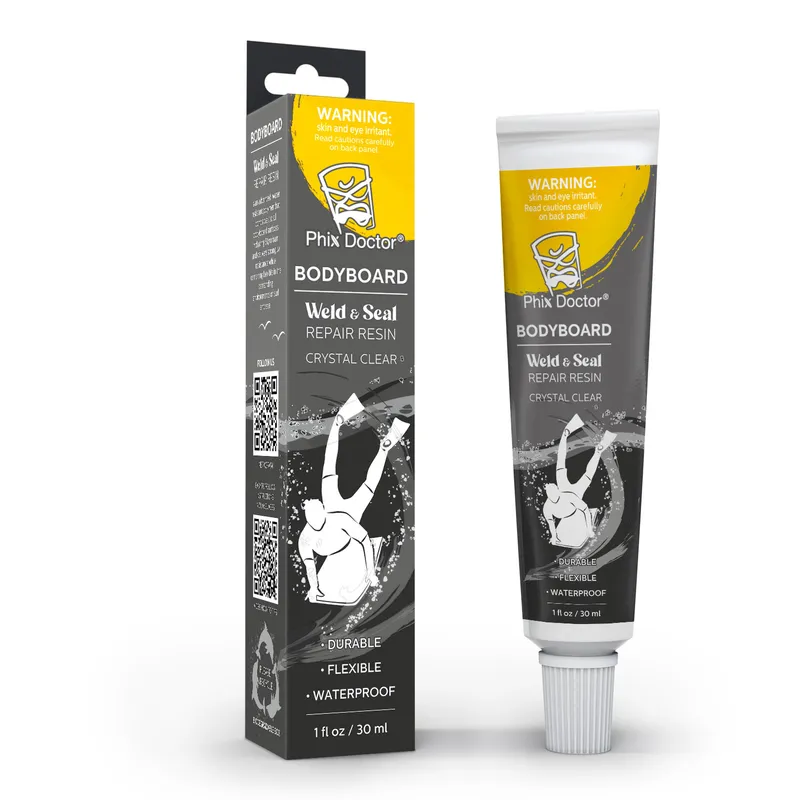
Because bodyboards are built to flex continuously, a rigid repair resin will crack out of the repair zone as the board works. The Bodyboard Weld & Seal Repair Resin is formulated to remain super flexible after cure precisely to move with the board rather than against it — and it bonds directly to EPS, Arcel, HDPE, PE, PP, rubber, wood, and EVA, covering every interface layer in both constructions described above.
Why a Rigid Resin Is the Wrong Tool — and What to Use Instead
Rigid resins fail on flexible boards because the repair cures stiffer than the surrounding material, and the board flexes around it on the next session until the repair cracks straight back out.
That mechanical mismatch alone disqualifies standard hard epoxy. Polyester laminating resin has a second, more immediate problem: it carries styrene monomer — not an inference, but a named chemical on the label, listed under a California Proposition 65 cancer warning. Styrene is a solvent, and it dissolves EPS (expanded polystyrene) foam on contact. Polyester resin must not touch an EPS core. If you use it on a bodyboard with an EPS or Arcel core, you are not repairing the board — you are actively destroying it from the inside.
Styrene, the solvent polyester resin carries, dissolves EPS foam cores. Never allow polyester resin to reach the foam, and on a bodyboard that contact is almost impossible to prevent.
The correct tool is a flexible bonding polymer formulated specifically for the materials a bodyboard is actually made from. The Bodyboard Weld & Seal Repair Resin 1 fl oz ($11.90) is ultra-clear, UV-resistant, super-flexible, and fully waterproof. It bonds to EPS, HDPE slick bottoms, Arcel, PP, PE, EVA, Rubber, Wood, and Metal — covering every inner and outer material a bodyboard is likely to have. Because it stays flexible after cure, it moves with the board rather than fighting it.
Cure times are straightforward: medium strength at 24 hours, full cure at 48 hours. Beyond filling dings and pressure dents, the same resin handles delaminations, split seams, loose leash plugs, and bodyboard fins — one product for the repairs that actually come up.
The Four Common Repairs — and the Rule That Governs All of Them
One rule governs every bodyboard repair: clean the surface thoroughly, let it get genuinely dry, and build up in layers rather than attempting a single thick fill. Rushing any of those three steps is how repairs fail — not the resin, not the foam.
The Bodyboard Weld & Seal Repair Resin is the tool for all four repairs below. It's an ultra-clear, UV-resistant, super-flexible waterproof polymer that bonds to EPS, HDPE, Arcel, PP, PE, EVA, and rubber — the full range of materials a bodyboard is actually made from. Medium-strength cure lands at 24 hours; full cure at 48 hours. Keep both timings in mind before you paddle out again.
How it works — the four repairs in sequence
- 1Delamination between deck and core.Work the polymer into the void with a thin tool so it reaches the full depth of the separation. Press the faces together firmly and hold. If the gap is deep, resist the urge to flood it — apply a first layer, allow it to reach medium cure (24 hours), then add a second pass if the void still shows. A flexible bond that fills the space completely is the goal, not a stiff plug.
- 2Split seams and rails.Clean both faces of the split and make sure no sand, wax, or moisture remains in the crease. Apply the polymer to both surfaces, press together, and allow a full 48-hour cure before the board flexes again. Rail splits take real mechanical stress on every wave; cutting the cure time short here is the most common reason a seam reopens.
- 3Torn or lifted slick bottom (HDPE).The slick is a bonded HDPE sheet, and the polymer bonds directly to it. Clean the lifted edge and the foam beneath it, then apply the resin in thin layers rather than one heavy bead. Thin layers conform to the slight curve of the slick and flex with it; a thick single application is more likely to peel at the edges under load.
- 4Crushed or gouged nose foam.Fill the void in layers, letting each reach medium cure before adding the next. This keeps each layer from sagging or skinning unevenly as it sets. The finished repair will be crystal clear and flexible — it will move with the nose rather than cracking away from it.
The Bodyboard Weld & Seal produces a durable, flexible, waterproof bond — it does not restore the structural integrity of the original moulded foam or return a crushed nose to factory compression resistance. Repair to ride safely, not to sell as new.
At $11.90 for 1 fl oz, a single bottle covers multiple repairs across all four categories above.
Skimboard Repairs: Wood, Composite, and When Not to Bother
Skimboards split into two constructions — solid wood and composite (fiberglass skin over an EPS foam core) — and the repair logic differs enough between them that picking the wrong product can destroy the core.
Wood skimboards are straightforward. Split edges, delaminated top skins, and waterlogged seams are all bond-surface problems, and the Bodyboard Weld & Seal Repair Resin lists wood explicitly among the materials it bonds to. Its flexible, waterproof polymer handles the flex cycles a skimboard takes on wet sand without cracking out of the repair.
Composite skimboards with EPS cores need the same resin for a different reason: polyester resin carries styrene monomer, which dissolves expanded polystyrene on contact. The Bodyboard Weld & Seal is formulated to bond directly to EPS, so it can fill a ding that reaches the foam without eating the core out from underneath. Polyester is not a substitute here, regardless of how it is applied.
Styrene monomer in polyester resin dissolves expanded polystyrene. If the ding exposes foam on a composite skimboard, use only an EPS-safe resin such as the Bodyboard Weld & Seal.
Decision Tree
- Bodyboard Weld & Seal bonds to wood and handles flex.Wood board, split edge or delaminated skin
- Bodyboard Weld & Seal; it is EPS-safe where polyester is not.Composite board, ding reaches EPS foam
- Replace the board; no resin restores structural integrity at that scale.Core is waterlogged throughout, or deck skin has lifted over more than half the board
- Replace; a through-crack cannot be returned to a rideable shape with surface resin.Board is kinked or cracked through the structure
The "not worth it" line is worth stating plainly. Resin fills voids and re-bonds surfaces — it does not reverse a waterlogged core, re-adhere a skin that has separated across the majority of the deck, or straighten a board that has kinked through. Attempting those repairs wastes time and product and produces a board that will fail again quickly. If the damage is that extensive, the honest answer is a new board.
What to Buy: Products and Prices
Three items cover the full repair job — resin, prep, and finish.
The core repair tool is the Bodyboard Weld & Seal Repair Resin 1 fl oz at $11.90. It's a single-application polymer formulated specifically for the materials bodyboards and skimboards are actually made from: EPS (styrofoam cores), HDPE slick bottoms, Arcel, PP, and PE. The resin is ultra-clear, UV-resistant, super flexible, and waterproof — meaning it moves with the board rather than cracking out. It handles deep holes, delaminations, rips, split seams, loose leash plugs, and fin attachments. Medium-strength cure lands at 24 hours; full cure at 48 hours.
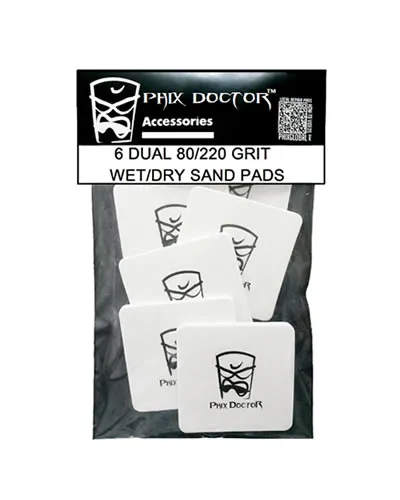
For prep and finishing, the 6 Dual Grit Sand Pads are $3.95 for a six-pack of 3" × 3" pads. Each pad is dual-grit (80/150), foam-centered for even pressure, and made with white silica — which matters because darker silica particles can show through a clear repair and look exactly like what you were trying to fix.
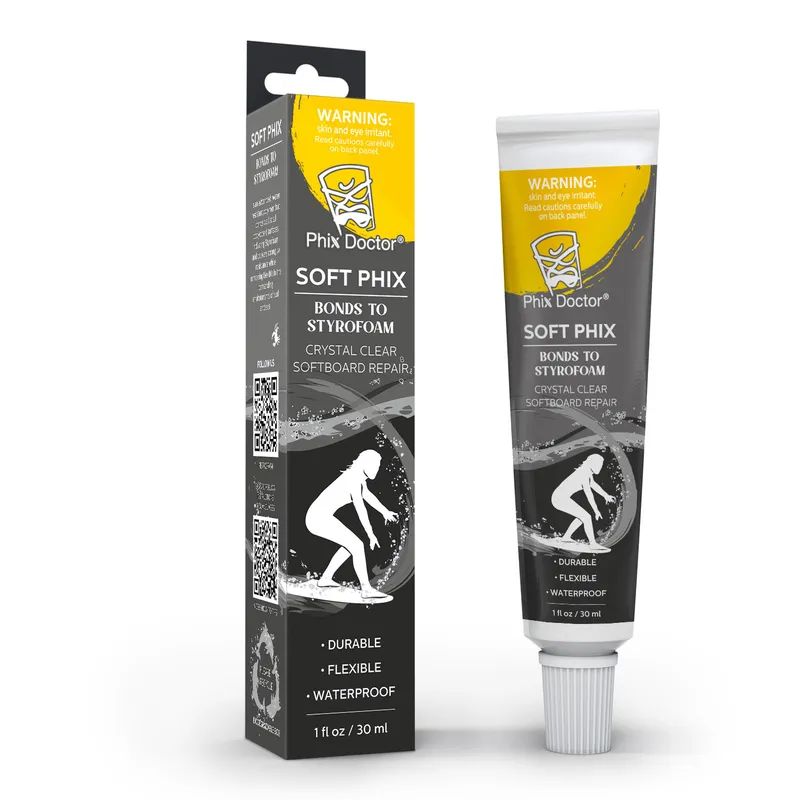
If you're working on a softboard rather than a traditional bodyboard, the Soft Phix Softboard Repair Kit 1 fl oz is also $11.90. Its formula is super flexible, waterproof, and durable enough to hold through regular use rather than breaking down after a few sessions. It also has an endless shelf life, so a half-used tube won't be dead the next time you need it.
The Bodyboard Weld & Seal and the Soft Phix kits are purpose-built for different constructions. Use each on the board type it's designed for — the material bonding and flexibility characteristics are specific to those substrates.
Frequently asked questions
Can I use surfboard resin to fix my bodyboard?
A rigid surfboard resin is the wrong choice for a bodyboard. Once cured, a rigid repair cannot flex with the board and will crack back out. Polyester resin is additionally unsafe on EPS foam cores because the styrene solvent it carries dissolves the foam. A flexible bonding polymer rated for EPS, HDPE, and PE — such as the Bodyboard Weld & Seal — is the appropriate tool.
How do I fix delamination on a bodyboard?
Clean the delaminated area and let it dry completely. Work the Bodyboard Weld & Seal into the void between the layers, press the surfaces together, and build up in layers if the gap is deep rather than filling it in one application. Allow medium-strength cure (24 hours) before light handling and full cure (48 hours) before use.
What glue works on a bodyboard slick bottom?
The slick bottom of a bodyboard is typically HDPE (high-density polyethylene), which most adhesives will not bond reliably. The Bodyboard Weld & Seal is specifically described as bonding to HDPE slick bottoms, along with EPS, Arcel, PP, and PE — the other materials found in bodyboard construction.
How long does bodyboard repair resin take to cure?
The Bodyboard Weld & Seal reaches medium-strength cure in 24 hours and full cure in 48 hours. Build the repair in layers rather than one thick application, and allow each layer adequate time before adding the next.
Is a skimboard worth repairing or should I replace it?
A split seam, lifted skin, or localised gouge on a structurally sound board is worth repairing. If the core is waterlogged throughout, the deck skin has separated over most of the board, or the board is kinked or cracked through its structure, repair is unlikely to produce a rideable result and replacement is the practical answer.